- Spring Media
- Posts
- How We Grew Email Revenue 92% in 30 Days (Peptide Brand Case Study)
How We Grew Email Revenue 92% in 30 Days (Peptide Brand Case Study)
The Thursday Brain Download

Arik Ahluwalia
April 02, 2026 • Estimated Reading Time: 4 minutes
Hey, it's Arik.
I want to share something with you that perfectly illustrates why I'm so bullish on the peptide space right now. We've been absolutely crushing it with peptide brands lately, and the results we're seeing are honestly insane.
This case study is from a peptide brand we've been working with, and what happened between February and March is a perfect example of what's possible when you get email marketing right in a high-growth industry.
In just 30 days, we increased their email revenue from $1.2M to $2.3M, a 92% increase. This was achieved by strategically optimizing both their automated flows and campaign strategy to create compound growth.
Let me walk you through exactly what we did and what you can learn from this, whether you're in peptides, supplements, or any other industry where customer education and retention matter.
The Starting Point: February Performance
In February, this brand was already doing well. $2.6M in total store revenue with $1.2M attributed to email marketing through Omnisend. That's about 46% of their total revenue coming from email, which is exactly where you want to be for a brand with strong customer relationships.

But when I looked at the breakdown, I saw a massive opportunity. Their automated flows were doing the heavy lifting, generating $1.1M (91.5% of email revenue) while campaigns were only contributing $109K (8.4% of email revenue).
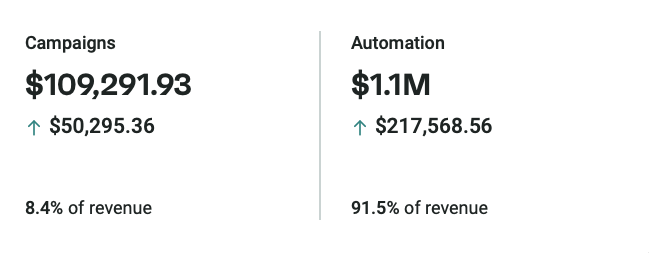
This imbalance meant they had good products and strong customer relationships, but their campaign strategy wasn't maximizing the potential of their growing email list.
They had 57.8K email subscribers and 18.9K SMS subscribers, with healthy growth rates and low unsubscribe rates. The foundation was solid, we just needed to build on it strategically.

The Strategy: Flows and Campaigns Working Together
A lot of brands think that flows and campaigns are separate things. Flows handle automation, campaigns handle promotions, and never the two shall meet. But the best email strategies use flows and campaigns as a coordinated system.
Flows create the foundation of consistent revenue and customer education, while campaigns create spikes, test new messaging, and amplify what's working in the flows.
For this peptide brand, we focused on two main areas:
1. Optimizing the flow foundation: Even though flows were already performing well, we knew we could improve them. In the peptide space, customer education is crucial because people need to understand how to use the products, what to expect, and why consistency matters.
2. Scaling campaign strategy: The campaign performance told us there was huge untapped potential. With a growing list of engaged subscribers, we should have been able to drive much more revenue through strategic campaigns.
What We Actually Did
Flow Optimization:
A lot of their flows were already working, they just needed some restructuring, and some design and messaging upgrades.
We improved the welcome series to better educate new customers about compound usage depending on their category of interest.
We also added two new core flows that they were missing: a site abandonment (when someone visits the website but doesn’t start browsing), and the checkout abandonment (one of the most crucial flows in your set up to recover lost revenue).
Campaign Strategy:
This is where we made the biggest changes. We moved from sporadic promotional campaigns to a strategic campaign calendar that balanced education, social proof, and offers.
We created educational campaigns that taught subscribers about different peptides, we developed review spotlight campaigns to build social proof, and we implemented strategic promotional campaigns that created urgency around limited inventory or new product launches.
Most importantly, we segmented our campaigns based on customer behavior.
The Results: March Explosion
The March results speak for themselves. Total store revenue grew from $2.6M to $3.8M (46% increase), but the email performance was even more impressive.

Email revenue jumped from $1.2M to $2.3M, a 92% increase in just 30 days, and campaign revenue exploded from $109K to $486K, a 345% increase. We literally went from campaigns contributing 8.4% of email revenue to 20.3%.
Flow revenue grew from $1.1M to $1.9M, a 73% increase. Even though we focused heavily on campaigns, the flows continued to grow because more people were entering the funnels and the optimizations were working.
The audience growth was also impressive. Email subscribers grew from 57.8K to 74.2K (28% growth) and SMS subscribers grew from 18.9K to 32.3K (71% growth).

But what really tells the story is the order data. Email orders grew from 6,358 to 11,900, an 87% increase. We weren't just generating more revenue from the same customers; we were converting more people and converting them more frequently.
Why This Worked So Well
• Reason 1: We treated email as a complete system
Instead of optimizing flows and campaigns separately, we created a coordinated approach where each element supported the others. Campaigns drove people into flows, flows nurtured people for future campaigns, and both worked together to maximize lifetime value.
• Reason 2: We focused on education, not just promotion
In the peptide space, customer education is crucial. People need to understand the products and the reseach.
• Reason 3: We segmented based on behavior
Instead of sending the same campaigns to everyone, we segmented based on purchase history and engagement level. This made every message more relevant and effective.
• Reason 5: We balanced automation with human touch
While flows handled the consistent, predictable revenue, campaigns allowed us to respond to market opportunities, test new messaging, and create excitement around new products or limited offers.
The Compound Effect
What's really exciting about these results is the compound effect. The 92% growth in email revenue isn't just a one-month spike, it's building momentum for continued growth.
The larger email list (74.2K vs 57.8K) means more people entering the flows every day. The optimized flows mean higher lifetime value from each subscriber. The improved campaign strategy means more opportunities to drive revenue spikes and test new approaches.
This brand is now generating nearly $2.3M per month from email alone. At that scale, even small optimizations can have massive impact. A 10% improvement in flow performance is worth $190K per month. A successful campaign can generate $100K+ in a single send.
What This Means for Your Business
Whether you're in peptides, supplements, skincare, or any other industry where customer education and retention matter, there are specific lessons here you can apply:
1. Don't neglect campaigns if your flows are working well. Many brands get comfortable with flow revenue and don't invest in campaign strategy. But campaigns can dramatically amplify your results if done strategically.
2. Education-based campaigns often outperform promotional campaigns. Especially in industries where customers need to understand how to use products effectively, educational content builds trust and drives long-term value.
3. Segmentation is everything. The same message that converts a new customer might annoy a repeat customer. The more you can personalize based on behavior and purchase history, the better your results will be.
4. Social proof is incredibly powerful. Customer success stories and testimonials can overcome objections better than any sales copy you write.
5. Think systems, not tactics. The best email programs use flows and campaigns as a coordinated system where each element supports the others.
See you next Thursday,
Arik