- Spring Media
- Posts
- How We Increased ROAS from 2.56x to 3.16x in 30 Days
How We Increased ROAS from 2.56x to 3.16x in 30 Days
The Thursday Brain Download

Arik Ahluwalia
March 19, 2026 • Estimated Reading Time: 5 minutes
Hey, it's Arik.
I want to walk you through something we did recently for a skincare brand that perfectly illustrates why Google Ads performance is all about smart spending.
This brand came to us already running Google Ads and generating sales. They weren't starting from zero, which is actually a common situation. Most brands we work with have some version of Google Ads running, but they know it could be performing better and they're not sure exactly what needs to change.
Their challenge was that their account structure was holding them back from scaling profitably. They were getting results, but there was so much wasted spend and missed opportunity buried in the account that their true potential was completely hidden.
In just 30 days, we took their return on ad spend from 2.56x to 3.16x while actually increasing their revenue by 39%. Let me show you exactly how we did it and what you can learn from this, whether you're running Google Ads for skincare products or anything else.
The Starting Point: Good But Not Great
When we first audited this account, everything looked fine on the surface. They were spending money, getting conversions, and the ROAS wasn't terrible. But after digging deeper, there were inefficiencies everywhere.
Their branded search campaign (the ads that show up when someone searches for their brand name specifically) was cluttered with unnecessary keywords. They were bidding on variations and related terms that didn't need to be there, which was diluting their budget and making the campaign harder to manage.
Their shopping campaigns were all over the place. They were promoting every single product equally, even though some products converted way better than others. This meant they were spending money showing ads for products that rarely sold while underinvesting in their bestsellers.
The Performance Max campaigns, which are Google's automated campaign type, were also promoting underperforming products. These campaigns use machine learning to find customers, but if you feed them bad data by including products that don't convert well, the algorithm learns the wrong patterns.
None of these issues were catastrophic on their own, but together they were creating a situation where a significant portion of their ad spend was essentially wasted. The account was working, but it was working way harder than it needed to for the results it was getting.
The Strategy: Structure Before Scale
Our approach was based on a simple principle: you can't scale what isn't efficient. Before we even thought about increasing spend, we needed to fix the foundation.
We started with their branded search campaign because this is usually the highest-converting, lowest-cost traffic you can get. When someone searches for your brand name, they already know who you are and they're actively looking for you. Your job is just to make sure you show up and capture that intent.
We stripped out all the unnecessary keywords and focused only on their core brand terms using exact and phrase match. This meant we were only showing ads for searches that were clearly about their brand, not tangentially related terms that might include their brand name but weren't actually brand searches.
Then we changed the bidding strategy from manual cost-per-click to target impression share at 95%. This tells Google to bid whatever it takes to show up in the top positions for these branded searches 95% of the time. It sounds aggressive, but for branded terms it makes sense because you don't want to lose that traffic to competitors or let people click on organic results when you could be controlling the message with your ad.
Shopping Campaign Consolidation
The shopping campaigns required more work because there were multiple campaigns running with overlapping products and no clear strategy about which products should get priority.
We consolidated everything into a cleaner structure and then made some hard decisions about which products to promote. Not every product in your catalog deserves equal ad spend, and pretending they do is just burning money.
We excluded the underperforming products entirely from the main shopping campaigns. These were items that either had low conversion rates, low margins, or just weren't moving despite getting traffic. Instead of continuing to spend money promoting them, we focused the budget on products that we knew converted well.
We also implemented something called a branded shopping script. This automatically identifies and removes search terms from the branded shopping campaign that don't include the brand name. The reason this matters is that you want to keep branded and non-branded traffic separate because they behave completely differently and should be optimized differently.
When someone searches for your brand name and clicks a shopping ad, they're much more likely to convert than someone who just searched for "moisturizer" and happened to see your ad. If you mix these together, you can't optimize properly for either one.
Performance Max Optimization
Performance Max campaigns are interesting because they're highly automated, which can be great or terrible depending on how you set them up. Google's algorithm will try to find customers for you, but it needs good data to learn from.
We had two Performance Max campaigns running: one focused on new customer acquisition and one catch-all campaign for everyone else. The new customer campaign was promoting some products that just weren't working for first-time buyers, so we removed those and let the campaign focus on products that actually converted well with new customers.
The catch-all campaign stayed broad to make sure we weren't missing any opportunities, but we gave it clear signals about what success looked like by assigning specific conversion actions and audience targeting.
The Ongoing Optimization Process
Beyond the structural changes, we implemented several ongoing optimization practices that most brands skip because they seem tedious. But this is where a lot of the performance improvement actually comes from.
Every week, we went through the search terms report to see what people were actually typing when they saw our ads. This is crucial because Google's keyword matching isn't perfect, and you'll often find that your ads are showing up for completely irrelevant searches. We systematically added these as negative keywords to prevent wasted spend.
We structured keywords according to intent and where people were in their buying journey. Someone searching for "best anti-aging serum" is in research mode and needs different messaging than someone searching for "buy retinol serum online" who's ready to purchase. We created separate campaigns and ad groups to match these different intent levels.
We also layered in audience targeting using data from Triple Whale, which tracks new versus returning customers. This let us bid more aggressively for new customer acquisition in campaigns where that was the goal, and adjust bids for returning customers in campaigns focused on repeat purchases.
Throughout all of this, we were constantly excluding things that weren't working—underperforming products, locations where we weren't seeing good results, keywords that were eating budget without converting. It's not exciting work, but it's what actually moves the needle.
The Results: What Actually Changed
Let me show you what happened when we compared the month after our optimizations to the month before.
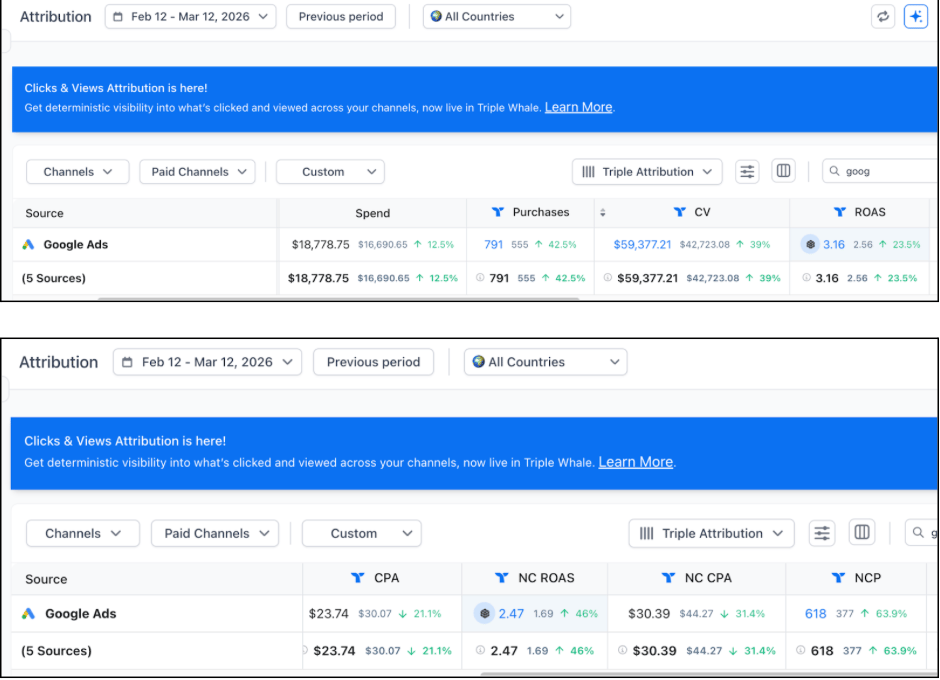
• Ad Spend: Increased by 12.5% from $16,690.65 to $18,778.75
• Ad Generated Revenue: Increased by 39% from $42,723.08 to $59,377.21
• Conversions: Increased by 42.5% from 555 to 791
• ROAS: Improved from 2.56x to 3.16x
• CPA: Decreased by 21.1% from $30.07 to $23.74
• New Customer ROAS: Improved from 1.69x to 2.47x
Why This Matters for Your Business
Whether you're selling skincare products or something completely different, the principles here apply universally.
Most Google Ads accounts have the same fundamental issues this account had: cluttered campaign structures, products or keywords that shouldn't be getting budget, branded and non-branded traffic mixed together, and no systematic process for ongoing optimization.
The fix isn't complicated, but it does require discipline. You need to be willing to exclude things that aren't working, even if it feels like you're limiting your reach. You need to separate different types of traffic so you can optimize each one properly. And you need to consistently review performance and make adjustments rather than just letting campaigns run on autopilot.
The brands that do this work see results like what I just showed you. The ones that don't keep wondering why their Google Ads performance is mediocre despite spending significant money.
What You Can Do Right Now
If you're running Google Ads, here are some specific things you can check and potentially fix:
• Look at your branded search campaign. Are you bidding on your exact brand name with exact and phrase match, or do you have a bunch of broad match keywords that are triggering for all kinds of searches? Clean this up and make sure you're dominating your branded traffic.
• Review your shopping campaigns. Are you promoting every product equally, or are you focusing budget on your bestsellers? Exclude products that don't convert well and let your winners get more traffic.
• Check your search terms report from the last 30 days. You'll probably find searches that have nothing to do with your products. Add these as negative keywords to stop wasting money.
• Separate new customer acquisition from retention. These require different strategies and should be in different campaigns with different targeting and bidding.
• Set up a weekly or biweekly review process. Google Ads isn't something you can set and forget. The accounts that perform best are the ones that get consistent attention and optimization.
See you next Thursday,
Arik